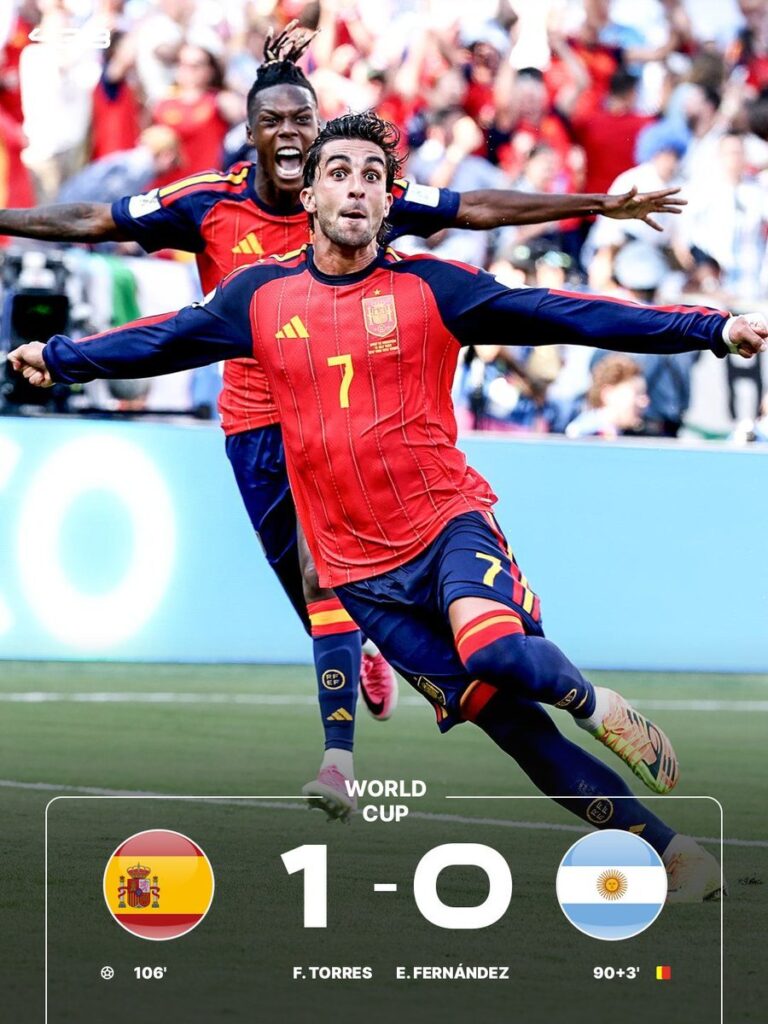
In a tense, physical, and ultimately dramatic 2026 FIFA World Cup final at MetLife Stadium in East Rutherford, New Jersey, Spain defeated defending champions Argentina 1-0 after extra time on July 19, 2026. Ferran Torres’ 106th-minute strike sealed La Roja’s second World Cup title—their first since 2010—while denying Argentina a historic back-to-back triumph.
The match was a cagey, attritional affair marked by Spain’s dominance in possession and chances, Argentina’s resilient defending (highlighted by goalkeeper Emiliano Martínez’s record-setting saves in a World Cup final), and simmering tension that boiled over at the final whistle. Spain outshot Argentina heavily, forced extra time after a scoreless 90 minutes, and benefited from Enzo Fernández’s late red card (second yellow for a reckless challenge on Pau Cubarsí).
The Match Turns Decisive
Spain controlled the tempo from the outset but struggled to break down a compact, streetwise Argentina side. A Nico Williams goal was controversially disallowed earlier, adding to the frustration. In extra time, Nico Williams delivered a pinpoint header back across goal, allowing substitute Ferran Torres to arrive at the far post and fire home from close range for the winner.
Torres’ celebration—arms outstretched, pure release—captured the moment Spain ended Argentina’s reign.
Post-Whistle Chaos Erupts
As the final whistle blew from referee Slavko Vincic, confirming Spain’s victory, the pitch erupted—not in unified celebration, but in confrontation. Several Argentina players, visibly devastated after playing with 10 men in extra time and falling short of defending their crown, charged toward the Spanish side.
Leandro Paredes was at the center of the flashpoint: he grabbed Spain’s Eric García by the neck amid the Spanish celebrations, then seized Gavi (wearing a substitute bib) by the shirt and shoved him to the ground. Nicolás Otamendi exchanged heated words with Spain captain Rodri, reportedly telling him he had been “crying all week.” Other skirmishes flared as emotions overflowed from a hard-fought final that had already featured physical challenges, tactical fouls, and a red card.

Videos and photos of the melee quickly spread across X (formerly Twitter), with users reacting in real time. Posts captured Scaloni sprinting onto the pitch, and commentators noted the “sore loser” optics from some Argentina players contrasted with cooler heads prevailing moments later. One widely shared Infobae post highlighted “the key intervention of Scaloni” with accompanying images of the chaos.
Scaloni the Peacekeeper
Argentina manager Lionel Scaloni emerged as the calm amid the storm. He rushed in to separate Paredes from García, worked with staff like Walter Samuel to de-escalate, and helped restore order. His presence prevented the situation from escalating further. Teammate Thiago Almada also moved to restrain Paredes.
Within minutes, tempers cooled. Spain players formed an honor guard, lining up to applaud and allow the Argentina squad to walk through for their runner-up medals—a gesture of respect that contrasted the earlier flare-up.
Scaloni’s Post-Match Reflection
In his post-match interview, Scaloni spoke with raw emotion and dignity:
“There is sadness, but also the knowledge that we gave it our all… The other team was better… We lose and we have to get back up again. That’s the only way. We know how to lose.”
He praised his players’ effort in reaching another World Cup final and emphasized sportsmanship: “We have to be big, because we know how to lose.” The message resonated widely on social media, with many praising Scaloni for modeling composure after the on-pitch tensions.
Lionel Messi sat on the turf in quiet reflection before rising to share a handshake and hug with Spain’s teenage star Lamine Yamal. Argentina players, many in tears (including Paredes), accepted their medals with visible disappointment.
Spain’s Triumph and Celebrations
For Spain, under Luis de la Fuente, it was vindication of a dominant cycle. The European champions added the world title to their résumé in emphatic style, becoming the first nation to hold both men’s and women’s World Cups simultaneously in some reports. Rodri was named Golden Ball winner.
Spain lifted the trophy amid fireworks, confetti, and roaring red-clad fans at MetLife Stadium. De la Fuente called it an “honor” to lead the group. Torres described his goal as one “scored by 47 million people.”
The incident, while ugly in the immediate aftermath, ultimately gave way to sportsmanship. Scaloni’s swift intervention and measured words turned a potentially damaging moment into one underscoring resilience and respect. Spain takes the trophy home as deserved champions of a grueling, record-breaking 48-team tournament. Argentina, despite the heartbreak, showed the heart that has defined their recent golden era—and left with heads held high after giving everything.
Spain are world champions once again. The 2026 final will be remembered for the football, the drama, and the grace that followed the storm.