By Ridah
Nairobi, November 19, 2026
A high-stakes consultative meeting between the Independent Electoral and Boundaries Commission (IEBC) and political party leaders descended into open confrontation on Thursday when a section of opposition leaders staged a dramatic walkout, accusing the electoral body of sidelining critical concerns raised by Kenyans ahead of the August 10, 2027 General Election.
Led by Democracy for the Citizens Party (DCP) leader and former Deputy President Rigathi Gachagua, Wiper Patriotic Front leader Kalonzo Musyoka, and Nairobi Senator Edwin Sifuna, the United Opposition delegation abandoned the session at Anniversary Towers (also referenced in some accounts as Iconic Hotel) before substantive discussions could begin. The group included former Interior Cabinet Secretary Fred Matiang’i, former Attorney-General Justin Muturi, former Chief Justice David Maraga, Siaya Governor James Orengo, Embakasi East MP Babu Owino, Martha Karua, Eugene Wamalwa, Jimi Wanjigi, Cleophas Malala, and others.
The leaders had arrived after a morning strategy session under the People’s Coalition on Electoral Reforms, where they settled on what they described as irreducible minimums for a credible poll. They insisted these issues, drawn from public concerns, were conspicuously absent from the agenda tabled by IEBC Chairperson Erastus Ethekon.
The Four Demands
The coalition’s proposals centre on four core reforms:
- A clean, audited, and verifiable national voter register, with the removal of duplicates, deceased persons, and other ineligible entries while ensuring all eligible Kenyans are registered.
- Abolition of the national presidential tallying centre at Bomas of Kenya, with results declared at constituency tallying centres treated as final and the national centre limited to receiving, aggregating, and announcing already-verified outcomes.
- Introduction of secure electronic voting for Kenyans in the diaspora.
- Mandatory livestreaming of voting, counting, and declaration of results at polling stations and tallying centres.
Gachagua and his colleagues also cited earlier correspondence — including a January 28, 2026 meeting and letters dated February 12, May 10, and June 24 — seeking a joint technical team and regular engagement, which they said had gone unanswered. “We have many issues given to us by the people of Kenya that are not on the agenda,” Gachagua told the meeting. “As it is, we are unable to participate.” He later posted that the commission’s stance amounted to “mockery of democracy and freedoms that the people of Kenya have fought for,” adding that the opposition would re-engage only “once you decide to listen to the 55 million Kenyans.”
Kalonzo was equally blunt: “We came to the IEBC today in good faith, and we expected the same in return. Good faith is shown in deeds: an independent, impartial and prepared Commission. Today, we did not find it.” Outside the venue he declared that the group would “not sit in a room and lend our names and faces to the formalisation of a bundled election.”
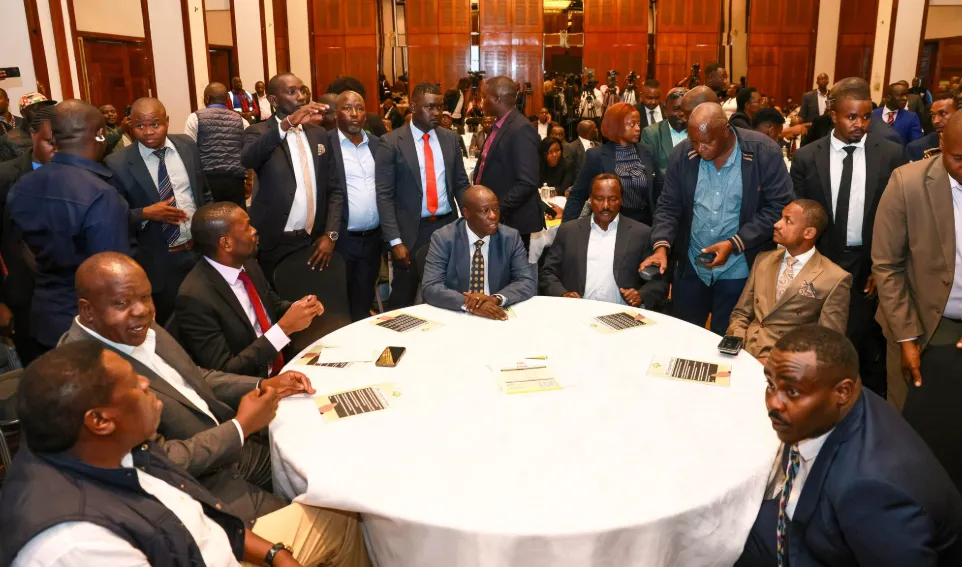
Supporters outside the venue chanted “One Term,” a pointed reference to President William Ruto’s re-election prospects.
Counter-Reactions and IEBC Response
The walkout, which some accounts say occurred as the ruling-coalition side was invited to speak or after Kisii Governor Simba Arati (ODM Deputy Party Leader, aligned with the broad-based government) took the floor, drew sharp criticism from those who remained. Arati labelled the departing leaders “cowards,” told the chair the meeting should proceed with “the courageous ones,” and questioned the credentials of some in the opposition delegation, describing elements of it as political “joyriders.”
UDA National Chairperson Cecily Mbarire, representing the ruling side, faulted the IEBC for allowing what she termed uninvited individuals and political theatre, warning that such scenes undermined the commission and turned forums into survival contests. National Assembly Majority Leader Kimani Ichung’wah also questioned the mobilisation of supporters.
IEBC Chair Ethekon described the departure as “very unfortunate” and “very sad,” stressing that the session was meant to clarify preparations and address queries from parties and the public. He indicated the commission would continue broader stakeholder consultations from the following week and urged cooperation for a successful election.
President Ruto later mocked the opposition’s approach, suggesting those confronting the IEBC were already preparing for defeat and had yet to settle on a candidate, while accusing them of disturbing a body whose role is simply to count votes.
Broader Context
The confrontation comes with roughly 263 days to the 2027 polls and against a backdrop of lingering public distrust in electoral management. Concerns over the voter register, election technology procurement (including references to Smartmatic), the absence of a substantive CEO, and the independence of the commission have featured repeatedly in opposition statements. The People’s Coalition on Electoral Reforms, co-convened in part by Maraga and Muturi, had framed the four demands as non-negotiable safeguards against the kinds of disputes that have marked previous Kenyan elections.
While the opposition left the door open to future dialogue once their issues are placed on the agenda, the walkout underscored the fragile consensus-building environment facing the IEBC as it prepares for what is expected to be another tightly contested cycle. Whether the commission adjusts its engagement model or the two sides find common ground in the coming weeks will shape the tone of preparations for August 2027.