Interior Cabinet Secretary Kipchumba Murkomen has launched a blistering attack on former Deputy President Rigathi Gachagua, accusing him of orchestrating a carefully crafted campaign of vitriol, lies and ethnic jingoism designed to divide Kenyans, incite violence and bully politicians into joining his political fold.
In a strongly worded statement posted on X on Thursday, August 6, 2026, Murkomen said he had been following “with concern and shock” Gachagua’s recent public pronouncements and talks.
“His daily diatribe, interspersed with vitriol, misogyny, lies, ethnic jingoism and hate are carefully crafted to sow division, incite violence, extort and bully politicians to join his party and cement his imaginary status as a regional kingpin,” Murkomen stated. “A position that neither exists in the Constitution nor in our socio-cultural setups.”
The Interior CS described Gachagua’s rhetoric and activities as “inconsistent with someone who once held a high constitutional office, leave alone a decent human being.”
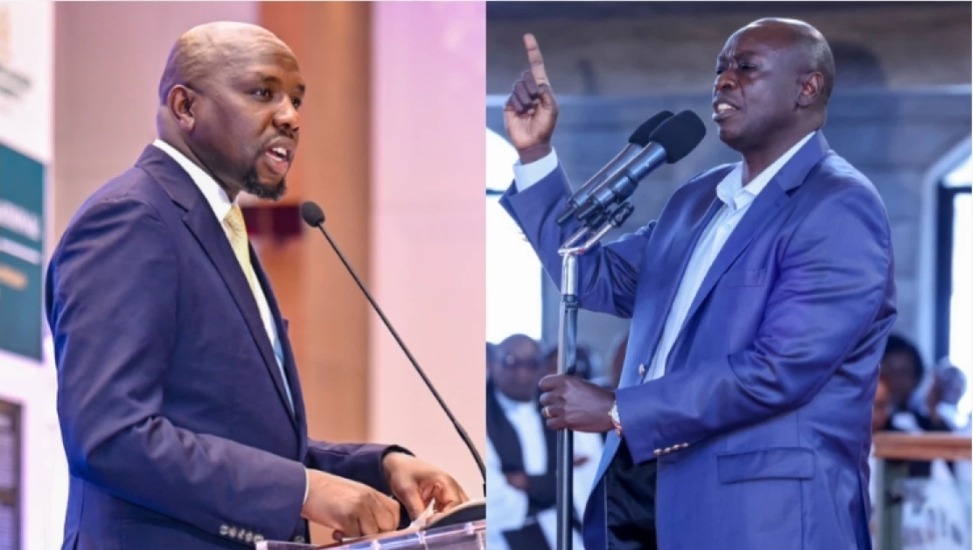
Murkomen accused the former Deputy President of using gatherings at his rural home in Wamunyoro — where he retreated after what Murkomen called his “self-inflicted fall” following impeachment — to systematically besmirch his name under the guise of criticising security failures.
In reality, Murkomen claimed, the attacks were a deliberate diversionary tactic. “He is trying to divert my attention away from the clandestine criminal activities that he executes through his lieutenants.”
After realising the verbal assaults had failed to shake the Interior ministry’s resolve, Murkomen said Gachagua had “changed tack and activated his sleeper cell of political accomplices from Rift Valley to aid him in his nefarious plot.”
He pointed to what he described as coordinated false accusations levelled against him by politicians from the Rift Valley in Parliament and public gatherings earlier in the week, which Gachagua then amplified.
“It is no coincidence that Gachagua was today amplifying the false accusations made against me by his co-conspirators,” Murkomen said. “Kingpinship is a vacuous title and the sole preoccupation of idle minds.”
The Cabinet Secretary urged Kenyans to remain vigilant against what he termed “this latest plot twist in Gachagua’s malignant influence.”
Despite the escalating political warfare, Murkomen insisted he remains focused on his mandate. “I remain steadfast and unwavering in discharging my duties, and when time allows, will join Wananchi in any part of the country in worship and other social activities as usual.”
How Gachagua Has Attacked Murkomen: A Pattern of Escalating Accusations
The August 6 statement is the latest salvo in a bitter, months-long public feud between the two leaders that intensified ahead of the 2027 general election, with Gachagua positioning his Democracy for Citizens Party (DCP) as a key opposition force.
Gachagua’s attacks on Murkomen have been frequent, sharp and personal, often delivered via lengthy X posts, speeches at his rural home and media interviews. They centre on allegations of incompetence, state-sponsored violence, abuse of power and political ambition.
In late June 2026, around the first anniversary of the Gen Z protests, the exchanges turned particularly heated. After Murkomen warned of intelligence reports that political actors planned to infiltrate demonstrations with goons and criminal gangs, Gachagua hit back hard on X. He branded Murkomen “the most clueless Minister in charge of security since independence,” accused him of recruiting, financing and deploying the very goons he claimed to be warning about, and claimed the CS had taken over the National Police Service to create a “parallel command” while introducing “goonism” into the force.
Gachagua further alleged that Murkomen headed a rogue police unit code-named “Nairobi Sierra,” which he claimed had attacked a church in Othaya (Witima ACK) and was redeployed to target him and his allies in the Mt Kenya region. He suggested senior officials, including Murkomen, were behind assassination plots and warned of International Criminal Court consequences.
In subsequent weeks, Gachagua continued the offensive. He accused Murkomen of orchestrating violence and deploying “state-sponsored militia” and “killer squads” during the July 2026 Ol Kalou parliamentary by-election, claiming abductions, beatings of DCP supporters and disruption of campaigns. In one X post, he stated Murkomen had dispatched the same Nairobi Sierra unit to cause mayhem there.
He has also linked Murkomen to alleged revival or mobilisation of outlawed groups like Mungiki to intimidate opponents, claimed new “killer” police units were being trained in Moyale under the CS’s watch, and repeatedly called for President William Ruto to sack him over security failures, including purported breaches involving the President himself.
Most recently, in the days leading to Murkomen’s August 6 statement, Gachagua accused the Interior CS of neglecting official duties while using state resources — specifically funds generated through the eCitizen platform — to charter helicopters for regular weekend tours across the Rift Valley. The goal, Gachagua claimed, was to position himself as the region’s political kingpin after Ruto’s tenure. These claims were amplified alongside criticisms from Rift Valley politicians in Parliament, which Murkomen directly referenced.
Throughout, Gachagua has portrayed Murkomen as a reckless, childish and ethnicising figure who politicises security agencies and protects goons while failing ordinary Kenyans.
Murkomen has consistently dismissed these as “clout-chasing,” “reverse psychology,” ethnic bigotry and attempts to create fear for political gain. He has labelled Gachagua the “father of violence,” “Lord of Violence and Master of Ethnic Bigotry,” and a threat to national unity, while insisting security agencies are monitoring inflammatory rhetoric and will act within the law.
The sharp exchange underscores deepening political polarisation as rival camps jostle for influence ahead of 2027, with security, ethnic narratives and allegations of organised violence increasingly central to the contest between the government and Gachagua’s opposition efforts.